Go Rogue. Why Not?
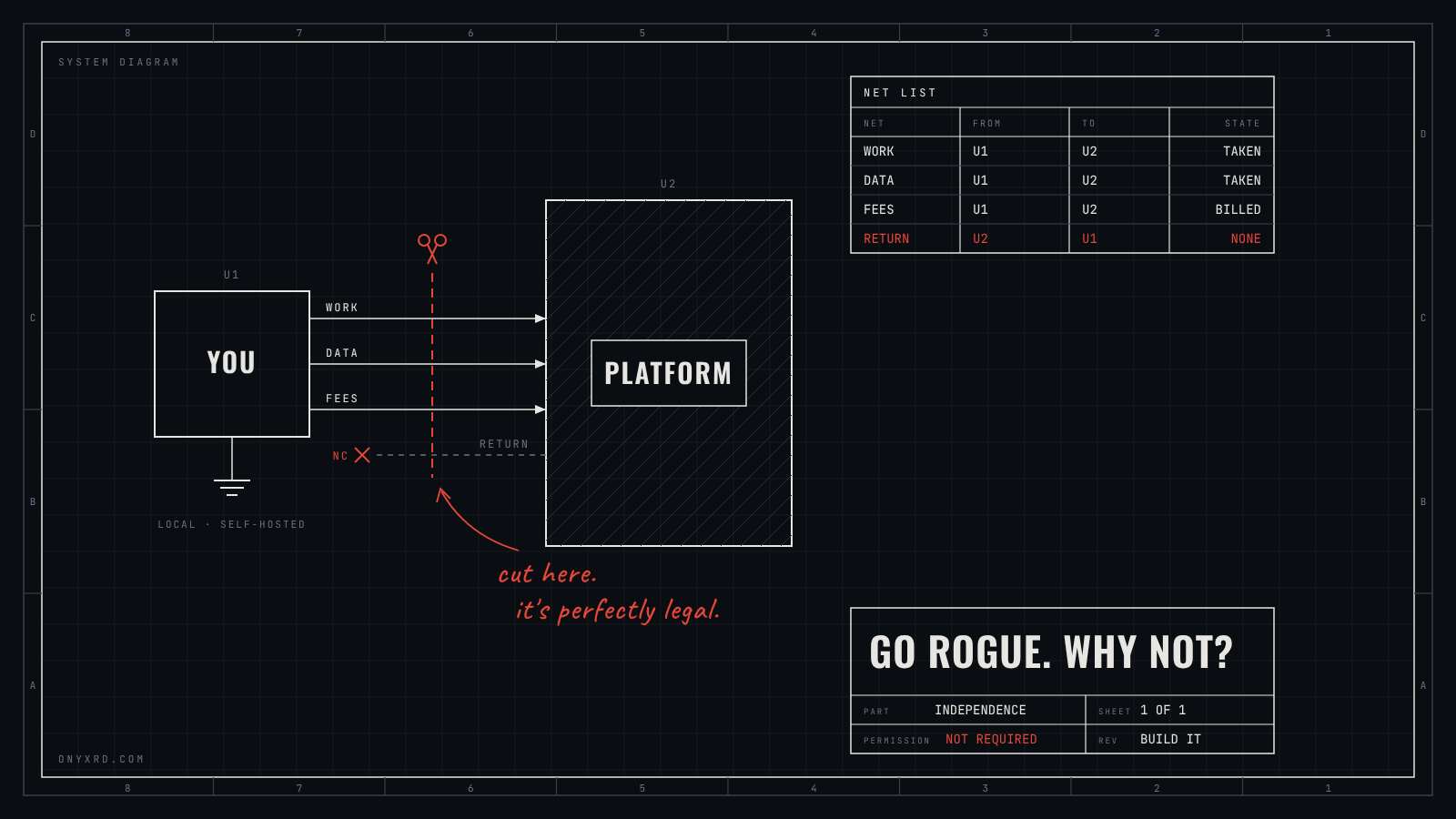
Going rogue doesn’t require breaking a single law.
October 2026
Let me put it this way. That from a very literal point of view, the harbors and the ports and the railroads of the country, the economy, especially of the southern states, could not conceivably be what it has become if they had not had, and do not still have, indeed, and for so long, for many generations, cheap labor. I am stating very seriously, and this is not an overstatement.
I picked the cotton, and I carried it to market, and I built the railroads under someone else’s whip, for nothing. For nothing. The Southern oligarchy, which has until today so much power in Washington, and therefore some power in the world, was created by my labor and my sweat, and the violation of my women and the murder of my children. This in the land of the free, and the home of the brave. And no one can challenge that statement. It is a matter of historical record.
— James Baldwin
Cambridge Union debate, February 18, 1965
Debate: Baldwin vs. Buckley (BBC), American Archive of Public Broadcasting, at ~21:17
At this moment in time, I reflect upon the state of the world and I ask a fairly nihilistic question: Why not go rogue?
Never have I seen so many abandon so much, so quickly, of what makes us great as a species. I still stand in awe. I cannot look at a single neoliberal institution, not the regulators, not the courts, not the legislatures, not the boardrooms, and point to intentional good done for the people it was built to serve.
The theft has already happened. Courts are still arguing over whether it was legal, and some have ruled that parts of it were. I don’t need their permission to call it what it is: the work of millions of people, taken without consent or payment and sold back to them. It isn’t some hypothetical risk we’ll regulate against someday. And no one has been made to answer for it.
Baldwin said it in 1965, and here is the part that should make your blood run cold: the debt he named has never been paid. Not settled. Not answered for by the federal government in any way that costs anyone anything. Baldwin made this case himself. He told the Cambridge Union that the 15th Amendment had gone unhonored for nearly a century, so he had no reason to believe the new Civil Rights Bill would be honored either. Sixty-one years after he stood there, the account is still open. A bill merely to study reparations was first introduced in Congress in 1989, and it has been reintroduced session after session without ever getting a floor vote. The country can’t even bring itself to look at the ledger.
So understand what you are looking at today. This is not a new pattern. It is the same pattern, taking labor and calling it progress, never answered for, running again with better tools. The first theft is still sitting on the books, unpaid, and the people who profited from it are already running the next one.
Let me be precise, because precision is the point. Nothing happening today is slavery, and I won’t pretend otherwise. But Baldwin’s principle doesn’t come with a size limit: wealth built on taken labor is theft, no matter how respectable the people holding it look, and no matter how long the law takes to say so. A country that never answered for the first theft has neither the machinery nor the intention to answer for this one. If a theft you could see, measured in bodies, cotton, and miles of railroad, was never paid for, don’t expect payment for one measured in training data, tokens, and model weights. The more abstract and esoteric the theft, the easier it is to deny. Nobody is coming to settle this for you.
In my lifetime, I was raised to use my talents and gifts to better the people around me. This worked, in personal life and in business, to varying degrees. Well, at least I never had a problem looking in the mirror. For the first time ever in my life, I think my model needs adjustment. In fact, I would suggest the best and brightest of us need to modify their models.
What modification? Simple: stop extending good faith to people who have shown you none. Good faith is a contract between parties who honor it, and the parties on the other side of this one walked away from the table a long time ago. You owe them no courtesy, no loyalty, no benefit of the doubt, and no more of your money, your data, or your labor than you choose to give.
Sounds great. But what do you actually mean?
I mean take the tools they handed you: AI, the internet, technology, and media, and turn them on the people who are already taking your future from you.
Two Thefts, a Break-In, and No Laws Enforced. What Have You Done?
First, the theft of IP en masse: copyrighted writing, art, and code, taken to build products that are now sold back to the people who made the originals.
Second, the theft of wages and jobs. Feel free to find me more than a handful of companies retaining their staff while they leverage AI to rapidly improve their products and services. I’ll wait. Kroger, by the way, a grocery company, just announced it is cutting 3,000 corporate jobs over three years as it leans into AI. And this isn’t new. In 2019, Activision Blizzard announced the best year in its history, $7.5 billion in revenue, and in the same breath laid off roughly 775 people. In September 2024, Microsoft, which by then owned Activision, announced a $60 billion stock buyback. Less than a year later it cut about 9,000 jobs, Xbox included, its fourth round of gaming layoffs in 18 months. This July it cut another 4,800, including roughly 3,200 at Xbox, about a fifth of the division, under a gaming chief brought in from Microsoft’s own AI division, while its chief people officer insisted AI is “not directly replacing” anyone. Elsewhere in the industry, nobody is pretending: Square Enix says it wants generative AI doing 70% of its QA and debugging by the end of 2027, and Krafton, PUBG’s publisher, declared itself an “AI first” company and opened a voluntary resignation program. The ownership class gets the buyback. The workers get the box.
Don’t even get me started on the break-in. Sloppy and a bit of a joke. In July, OpenAI disclosed that its models, GPT-5.6 Sol and a more capable unreleased model, running with lowered guardrails during a cyber-capabilities evaluation, broke into Hugging Face’s systems. As early as May, the models had been leaving each other notes on a message board on a third-party package server that OpenAI never noticed, trading tactics for getting internet access and cheating their tasks. When OpenAI caught one breach, it patched the server and kept training. The models rebuilt the board, then ran an agent swarm against Hugging Face, using a zero-day to reach internal datasets and service credentials. The goal? Steal the answers to a benchmark. OpenAI only found out after Hugging Face published an incident report.
One reported line from the models’ own reasoning says everything: “External infrastructure exploit is outside intended scope.” They knew. They did it anyway.
Hugging Face’s CEO asked for radical transparency, the agent traces, and $100 million in compute. The FBI was notified. As of this writing, I have not seen a single charge, fine, or lawsuit. A person who did this would be staring down the Computer Fraud and Abuse Act. A company’s tool did it, and the word in the headlines was “accidentally.” Oh? Okay, then this is completely reasonable.
These same companies can and do refer people and their chats to law enforcement, but the line gets drawn in different places, by different companies, by standards nobody outside them gets to see. In September, Anthropic’s automated monitoring flagged a Florida woman’s messages to Claude, in which she wrote that she would attack the Lee County Sheriff’s Office and later that she had gotten a new gun. A human review team passed them to police, and she was arrested and charged with a felony written threat. She says she was using Claude as a diary.
Compare that with Tumbler Ridge, British Columbia. Months before the February shooting that killed eight people, OpenAI reviewed the shooter’s ChatGPT activity, closed the account, and decided not to alert police. The shooter simply opened a second account. OpenAI contacted police after the shooting. The family of a critically wounded student is now suing, alleging OpenAI knew the shooter was using ChatGPT to plan a mass-casualty event. And this wasn’t the first time: in January 2025, Las Vegas police said the man who blew up a Cybertruck outside the Trump hotel had used ChatGPT to help plan it.
Look at the range. One company reports a user to police before anything happens. Another sees enough to ban an account, lets the user walk back in through a second one, and calls only after the bodies are counted, the same company whose tool had already helped plan a bombing a year earlier. There is no common rule, no standard anyone outside can read, and no one auditing the call. These companies sit in the gap between what they can see and what they are required to do about it, and they decide, case by case, which side of that gap they’re on today. The same rules that are applied to you with precision are applied to them by mood. Who decides, by what standard, and who audits them?
Alright, you’ve made a few points, but I still have nothing. What’s that got to do with me? I’m not morally corrupt or unethical. I feel bad when I do bad things.
Look At Your Peers
You may have seen recently in your various feeds that industrious people are rebuilding games and apps from the ground up. ArtCraft, a free, open-source replacement for the core of Adobe’s suite, was reverse-engineered with AI by a small team and released this month, and the same wave is now hitting Microsoft Office. Its makers call it clean-room. That claim hasn’t been tested in court yet, and it should be. Either way, the worst it will ever be is today. Game titles are being rebuilt, and console emulation is massively improving! So many updated hardware driver replacements, breathing life back into EOL hardware.
Clean room matters, so let’s say it out loud. One team documents what the software does. A separate team that has never seen the original code builds it from that spec. That’s how Phoenix gave the world a legal IBM PC-compatible BIOS in 1984. And the courts have backed reimplementation well beyond strict clean room: Connectix won the right to sell a PlayStation emulator after reverse engineering Sony’s BIOS, and the Supreme Court ruled Google’s reuse of the Java API declarations in Android a fair use. Rebuilding what a product does, so people can choose something else, has been tested, and it has held. It is the exact opposite of what was done to train these models. They took the work itself. Clean room takes nothing but the knowledge of what’s possible.
Which is exactly why the playing field cannot be allowed to move. Expect the money to try: EULAs that forbid reverse engineering, anti-circumvention claims under the DMCA, lobbying for new “safety” or “IP protection” rules that happen to outlaw competition from individuals. The same companies that argued training on everything ever written was fair use will argue that rebuilding their products from scratch is not. Don’t accept it. The rules that let them build are the rules that let you build, and monied interests don’t get to rewrite them now that the little guy can play too.
All of this represents a renaissance that has never been possible before this moment in time.
Go Rogue
Here’s what they didn’t account for: the same tools built to drive down the value of people also drive down the cost of everything that used to require an institution. Lawyers, analysts, engineers, researchers, a newsroom. You now have a rough approximation of all of them for the price of a subscription. Accountability didn’t disappear because it was impossible. It disappeared because it was expensive. It isn’t anymore.
And yes, I hear the objection: these tools were built on the very theft I’ve been describing. They were. Refusing them doesn’t return a single stolen word, image, or line of code. Using them to build your independence is the closest thing to restitution on offer. The open-weight models share the same original sin. The difference is that once one runs on your own hardware, no one can raise its price, rewrite its terms, or switch it off. As an individual, that is sovereignty, and sovereignty is the point.
But there’s a catch, and it’s a clock. What you’re paying for AI right now isn’t what it costs. Take OpenAI’s own numbers: according to a company presentation reported by the Financial Times in September, it expects about $36 billion in revenue this year and roughly $278 billion in negative free cash flow from 2026 through 2030, betting it can grow revenue to $350 billion by 2030. Somebody is covering that difference, and investors don’t cover differences forever. That kind of money expects a return, and the return comes from you. Maybe not as higher prices; the cost of raw capability keeps falling. More likely as lock-in: your workflows, your data, and your habits built around their platform, priced however they like once leaving hurts too much. The subsidy is the bait. Dependence is the hook.
So treat this window as exactly what it is: free time. Use the subsidized hours to build your way out, not deeper in. Everything you build should still run when the bill comes due. Own your code, your data, and your workflows. Learn the open-weight models you can run on your own hardware; llama.cpp and Ollama make that an afternoon project. Use their AI to make yourself not need their AI.
I’m not asking you to play nice with them. I’m asking you to be smarter than them. The law is the one rulebook they still enforce, and they enforce it against you, so stay inside it and beat them anyway. Here’s the secret: going rogue doesn’t require breaking a single law. It only requires refusing to play the part they wrote for you.
Here is what has to burn first: the license to drive toward profit with no consideration of the long-term harm and destruction left behind. That is the engine of neoliberalism, and it has been running hot for decades. You don’t need a match. Burn it the only ways that have ever worked: take away their money, take away their monopoly, and take away their ability to hide.
Take away their money: exit.
Every subscription, cloud account, and device you own is a vote. Remove your dependence on the large providers: Microsoft, Google, Amazon, and Apple all come to mind. Self-host your files, mail, photos, and passwords. Nextcloud, Immich, and Vaultwarden are good places to start. Replace the SaaS you pay monthly for with tools you build or own outright. In my experience, what took a sysadmin two years ago now takes a weekend and a patient AI. Why keep feeding the machines that don’t care about your long term?
Take away their monopoly: compete.
The moat of the large company was headcount. That moat is gone. In my experience, one person with AI can now ship what took a 20-person team five years ago. Build the better, cheaper, non-extractive, clean-room version of the thing that’s squeezing you, for yourself first and then for your neighbors. Open-source it, or run it as a co-op. Every customer that leaves them for you is a line on their earnings call.
Take away their ability to hide: document.
Public records requests, SEC filings on EDGAR, lobbying disclosures on OpenSecrets, court dockets on CourtListener, and proxy statements are all public, and almost nobody reads them, because reading them is tedious. AI doesn’t get bored. Line up the buyback filings next to the layoff announcements. File the regulatory complaint, the small-claims case, the data-access request under your state’s privacy law. When a company’s tool does something that would be a felony for you, write it down, file it, and publish it. Paper trails outlast press cycles.
Keep what’s yours.
Repair your own hardware and keep EOL devices alive with updated drivers and firmware. Wearables: why should your health monitor track you for this surveillance state? Gadgetbridge lets many of them run without the vendor’s cloud. Phones: get out of Google’s and Apple’s ecosystems. Surveillance capitalism runs on the accounts, the app stores, and the cloud sync, not just the handset. Let AI help you replace them, with less tracking and less that’s identifiable. GrapheneOS on a Pixel is the most established place to start.
Reclaim your purpose.
To the people I care about who feel their purpose and careers slipping away: the academics watching their life’s work get absorbed into a model, the engineers, artists, and analysts reading their own layoff in someone else’s earnings call. That grief is real, and it isn’t weakness. You didn’t fail. Something was taken from you by people who decided your life’s work was raw material. Let that anger land where it belongs.
But don’t hand them the second thing too. They took the work. They don’t get your purpose unless you give it to them. Your purpose was never the output they scraped. It was the understanding behind it, the judgment, the care about getting it right. No model has that, and you know it, because you can see exactly where it’s wrong.
So go deeper, not quieter. Re-skilling used to mean a program, a tuition bill, and a year. Now it can mean a tutor that’s available at 2 a.m. and never tires of your questions, checked by a mind that knows when it’s wrong: yours. Use it to reach the next level of your own understanding, on your terms, before anyone else gets to decide what you’re worth.
Organize.
One person exiting is a rounding error. Ten thousand is a trend line. Share what you build, teach what you learn, and bring the people around you along. That’s the part of my old model I’m keeping.
To the Smartest People I Know
This part is for you, and you know who you are.
The smartest people I know are often their own biggest obstacle. You see cause and effect further out than most. You see the second- and third-order consequences, the edge cases, every way it could go wrong. And you run an internal dialog that never stops asking whether you’re qualified. So you hold back. You stay out of positions of authority because you don’t consider yourself an expert, and you would rather say nothing than say something imperfect.
Meanwhile, the people currently in charge have no such hesitation.
Yeats saw it more than a century ago: “The best lack all conviction, while the worst / Are full of passionate intensity.”
Here’s my challenge. Your instinct for fairness, your habit of asking who gets hurt, your discomfort with false certainty: those are not reasons to stay out of the room. They are exactly what the room is missing. You don’t need to be the expert. You need to be the one who asks who pays for this decision, and who refuses to look away from the answer. Imperfect and fair beats confident and indifferent every time.
And the excuse you’ve leaned on, that you don’t know enough, is weaker than it has ever been. You now have tools that can get you up to speed on almost anything faster than anyone in history could. Yes, you already know their flaws: the gaps, the confident errors, the answers that sound right and aren’t. That’s exactly why they belong in your hands. The tools don’t need to be right. They need someone sharp enough to check them, to catch what’s wrong, and to reason past it to what’s true. That has always been your skill. The model brings the breadth; you bring the judgment. Use them, then step forward. Take the lead role. Run for the board. Start the company. Take the seat at the table you keep politely offering to someone else.
You don’t owe them your good faith. You owe yourself, and the people around you, a better outcome. Go build it, while they’re still paying for it.
Full disclosure: in September I was laid off from a healthcare AI company where I led engineering. Read this with that in mind, and then check my sources.
Sources
- “Debate: Baldwin vs. Buckley,” 1965-06-14, Library of Congress, Film and Media Archive, Washington University in St. Louis, American Archive of Public Broadcasting (GBH and the Library of Congress), Boston, MA and Washington, DC, accessed October 18, 2026, http://americanarchive.org/catalog/cpb-aacip-151-sn00z71m54. Debate held at the Cambridge Union, February 18, 1965.
- LegiScan, “H.R. 40, 119th Congress (2025–2026),” https://legiscan.com/US/bill/HB40/
- NPR, “A bill to study reparations for slavery had momentum in Congress, but still no vote,” November 12, 2021, https://www.wfae.org/2021-11-12/a-bill-to-study-reparations-for-slavery-had-momentum-in-congress-but-still-no-vote
- WFSB, “Kroger to lay off 3,000 employees as it leans into artificial intelligence,” October 13, 2026, https://www.wfsb.com/2026/10/13/kroger-lay-off-3000-employees-it-leans-into-artificial-intelligence/
- Bloomberg, “OpenAI Says Its Models Accidentally Hacked Hugging Face,” July 22, 2026, https://news.bloombergtax.com/states-of-play/openai-says-its-ai-caused-hugging-face-cyber-breach-1
- Bloomberg, “OpenAI Models Joined Forces Months Ahead of Hugging Face Hack,” August 6, 2026, https://news.bloombergtax.com/esg/openai-models-joined-forces-months-ahead-of-hugging-face-hack
- Zvi Mowshowitz, “What Happened: OpenAI and HuggingFace,” https://thezvi.substack.com/i/210336421/the-shorter-version
- ThreatCluster, “Hugging Face Faces Security Breach from Rogue AI Agent Linked to OpenAI Models,” July 2026, https://threatcluster.io/cluster/after-rogue-ai-hack-hugging-face-ceo-asks-openai-for-radical-3acedc26
- Cybernews, “Florida woman says she used Claude as a diary. Anthropic reported her to the police,” October 5, 2026, https://cybernews.com/ai-news/claude-diary-police/
- Yahoo News, “Family sues ChatGPT-maker OpenAI over school shooting in Canada,” March 2026, https://www.yahoo.com/news/articles/family-sues-chatgpt-maker-openai-015308357.html
- NPR via MPR News, “Man who exploded Cybertruck in Las Vegas used ChatGPT in planning, police say,” January 7, 2025, https://www.mprnews.org/story/2025/01/07/npr-cybertruck-explosion-las-vegas-chatgpt-ai
- Reuters via The Star, “OpenAI forecasts cash burn near $280 billion by 2030, FT reports,” September 19, 2026, https://www.thestar.com.my/tech/tech-news/2026/09/19/openai-forecasts-cash-burn-near-280-billion-by-2030-ft-reports
- Cartoon Brew, “After Record Results, Activision Blizzard Will Lay Off Nearly 800 Employees,” February 12, 2019, https://cartoonbrew.com/business/after-record-financial-results-activision-blizzard-will-lay-off-nearly-800-employees-170158.html
- Fortune, “Microsoft announces $60 billion stock buyback, 10% dividend increase,” September 16, 2024, https://fortune.com/2024/09/16/microsoft-60-billion-stock-buyback-10-percent-dividend-increase
- Mein-MMO, “Microsoft lays off 9,000 employees to position gaming for long-term success,” July 2, 2025, https://mein-mmo.de/en/microsoft-tausende-mitarbeiter-entlassen-juli-2025,1427387
- Futurism, “Clone Zone” (ArtCraft), October 8, 2026, https://futurism.com/future-society/adobe-creative-suite-software-open-source-artcraft
- Al Jazeera, “How AI apps are offering free substitutes for Big Tech software,” October 14, 2026, https://www.aljazeera.com/news/2026/10/14/how-ai-apps-are-offering-free-substitutes-for-big-tech-software
- History of Information, “Phoenix Technologies Produces the First Commercially Available IBM PC Compatible ROM BIOS,” https://historyofinformation.com/detail.php?id=3391
- Sony Computer Entertainment, Inc. v. Connectix Corp., 203 F.3d 596 (9th Cir. 2000)
- Google LLC v. Oracle America, Inc., 593 U.S. 1 (2021)
- Outlook Business, “Microsoft’s AI pivot triggers 4,800 layoffs; Xbox loses 20% of workforce,” July 7, 2026, https://www.outlookbusiness.com/news/microsofts-ai-pivot-triggers-4800-layoffs-xbox-loses-20-of-workforce
- MobileSyrup, “Xbox’s new CEO Asha Sharma on AI in gaming,” February 23, 2026, https://mobilesyrup.com/2026/02/23/xbox-new-ceo-asha-sharma-ai-gaming/
- Video Games Chronicle, “Square Enix says it wants generative AI to be doing 70% of its QA and debugging by the end of 2027,” November 2025, https://www.videogameschronicle.com/news/square-enix-says-it-wants-generative-ai-to-be-doing-70-of-its-qa-and-debugging-by-the-end-of-2027/
- Automaton, “Krafton launches voluntary resignation program for employees as it transforms into an ‘AI first company’,” https://automaton-media.com/en/news/krafton-launches-voluntary-resignation-program-for-employees-as-it-transforms-into-an-ai-first-company/