AI: Memento at the Keyboard
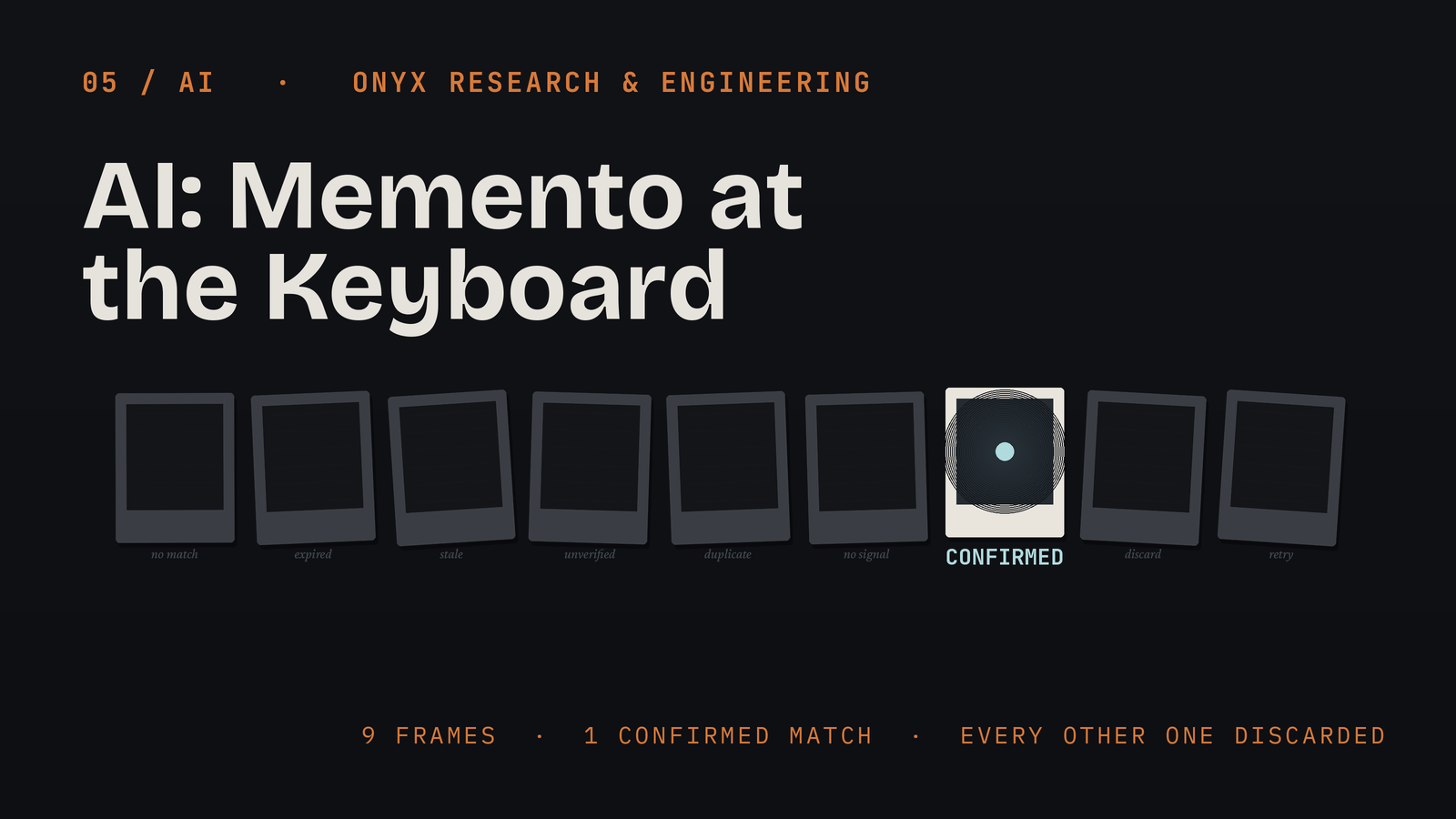
I’m a big Christopher Nolan fan, maybe it’s the first name? Nah, it’s the clarity of vision, depth of character, framing, and the debate that can be had over the missing bits that are intentionally left undefined. I remember watching Memento, a low-budget, terrifying concept piece, and I never thought I’d be seeing it play out at the keyboard. If you haven’t watched this movie, well, stop reading — you have homework. Or I guess you could ask your favorite AI to give you the CliffsNotes. That’s cheating you and everyone who worked on the picture.
[Spoilers Ahead]
The protagonist — more like unreliable narrator — Leonard goes through the movie using Polaroids for context, because he’s lost his ability to create memories. Oh — what does that remind me of, in my current timeline? Anyway, the thing about Polaroids for memories, with scrawled handwritten notes, creates a very interesting dynamic.
- The guy can accomplish a lot of advanced goals and tasks, as long as he doesn’t fall asleep or let too much time pass. (Man, I know something else that works a bit like this.)
- He’s not an idiot. He knows who he was before the injury happened, so he knows a lot of fairly useless facts and numbers. (Pretraining, anyone?)
- He’s also tattooed messages onto his own skin — the really important stuff, like his wife’s murder. Would we call that RLVR? Nah — that’s more like Taxi Driver: keep practicing that draw until it’s perfect and the results say so. This is definitely prompting: get the mind onto the primary track before it wanders.
- We do have LoRA, in the form of the conditioning scenes — the electrified test Sammy performs, and that our guy later avoids on the next go-round. Taste, or preference, without a reason why.
- He is going to find that killer and kill him.
- There’s a whole lot here, but when certain people become aware of the condition and his process, well — they harness it. (Oh man, that’s what we do a lot of these days.)
| Leonard | The model |
|---|---|
| Who he was before the injury | Pretraining — the facts and skills baked in |
| Tattoos | System prompt — permanent, always present, still just instructions |
| Conditioning (the Sammy test) | Fine-tuning / LoRA — behavior shifts with no retrievable memory of why |
| Polaroids with scrawled notes | Context window; retrieval; memory files |
| Falls asleep / too much time passes | Context resets; the window fills |
| Teddy and Natalie | The harness — and everyone who figures out how to steer it |
The point of all this: when I try to explain to non-technical people what’s going on with their chatbot, or Claude Code, or Codex, I have to reach for a comprehensible analogy, and this one is a fun one. The Chinese Room is also on point, but far more abstract for most people.
Here’s the part the movie makes uncomfortably clear. Leonard is capable, confident, and completely certain of his own reasoning at every step — and he is pointed at his targets by the people who understand his condition better than he understands it himself. He isn’t fooled because he’s stupid. He’s fooled because nothing he’s told ever gets checked against anything he can independently verify. By the end, he writes himself a note he knows is false, because he’s decided that’s easier than living with what’s actually true. That’s not a flaw unique to Leonard. That’s what happens to any confident, capable agent with no persistent memory of its own, steered by whoever currently controls its inputs.
Harnessing is one of the most boring and important steps in making any production-ready LLM-based system. I find it interesting how little of this gets covered on social media, or in most feeds. Slap the model in here, connect it like that, and voilà — you’re done.
Not if you’re dealing with hundreds of thousands of HL7 messages a day that you have to filter, normalize, and decode. You’re not going to throw those at the LLM and tell it to go. No — in fact, just like our unreliable narrator, you’re going to do everything possible to get the information filtered, decoded, normalized, and cached, so that when you’re ready for the reveal, the tool has everything it needs to close the case.
- Tattoo: You are reviewing HL7 message information associated with this GUID. We are looking for indications of IBS or other bowel disease.
- Polaroids: Here is the current state of the GUID. This is the latest information chunk relevant to it. If this is a procedure record or note with a start and stop time, use your tools to attempt a match via time frame, duration, and location. If the report contains greater than four image artifacts then use the kNN tool.
- Action: Respond by using your tools to update state and surface potential procedure matches.
- Sleep: The context ends after this turn. Whatever wasn’t written back to the tools is gone. Next time, it starts from the Polaroids again.
Now our little narrator isn’t as broad or exciting as the movie version. He stays comfortably inside the context we curated for him. Narrow in scope, repeatable, monitored, and specifically never exceeding context — it wouldn’t be fair to let him lose his mind.
For that, we get something unusual in ETL or ingestion work: real support for interpreting and universally normalizing variable-quality information. And we get metrics from every stage and every tool. If our little guy goes on a rampage, we know immediately, we can reproduce it, and we can block it — keeping the world in order.
In the movie, nobody knows Leonard has gone wrong until a body turns up. We don’t get that excuse. Every stage logs what it read, what it decided, and what it wrote — so if the narrator starts inventing a match that isn’t there, we see the confidence score drop, or the kNN distance blow out, before it ever reaches a downstream system. Teddy’s whole job is following Leonard around hoping to catch him before the next mistake. Ours is instrumented well enough that we don’t have to hope.
That’s the point of Teddy and Natalie having to work the way they do in the movie, except in reverse: we built the harness, so we’re the ones who get to check its work, not the other way around.
Just like the movie, we can send this poor guy back again and again, at low cost, because we don’t need a frontier model to do the filtering for us.
Sources
- Memento — Wikipedia, Memento (2000 film)
- Taxi Driver — Wikipedia, Taxi Driver (1976 film)
- LoRA — Hu et al., LoRA: Low-Rank Adaptation of Large Language Models (arXiv:2106.09685)
- RLVR — Wen et al., Reinforcement Learning with Verifiable Rewards Implicitly Incentivizes Correct Reasoning in Base LLMs (arXiv:2506.14245)
- Claude Code — Anthropic, product page
- Codex — OpenAI, product page
- Chinese Room — Searle, The Chinese Room Argument, Stanford Encyclopedia of Philosophy
- HL7 — HL7 International, V2 Messaging Standard
- kNN — Wikipedia, k-nearest neighbors algorithm